

Signal is one of the most secure messaging apps for private communication – end-to-end encrypted, open-source, and with very limited data collection. However, for organisation-wide use, it lacks the features that businesses and public authorities require: centralised administration, role-based access, controlled offboarding, audit-proof archiving and a robust crisis communication channel. This is not a security shortcoming, but a fundamental design choice. Signal protects individuals – not organisations.
Signal is installed on many work mobile phones. Usually without IT having made that decision. Staff install the app because it’s fast, because it’s free and because it’s regarded as ‘the secure messenger’. Anyone who has banned WhatsApp from their work environment almost automatically ends up using Signal – it’s an understandable reflex.
Nevertheless, it doesn’t quite add up. That’s because encryption and controllability are two different things. Signal solves the first problem brilliantly. It doesn’t solve the second.
Why Signal ends up on work mobile phones in the first place
Signal has earned its reputation. The Signal protocol is regarded as the gold standard for end-to-end encryption and is now used by numerous other messaging apps. The code is open-source and publicly verifiable. According to Signal itself, it stores only a minimum amount of data on its servers. It does not have a data-driven business model, but is run by a foundation.
Signal is therefore an excellent choice for private communication. The misconception arises only when it comes to transmission: ‘secure’ is tacitly equated with ‘suitable for organisations’. This is how Signal ends up in the corporate world.
For an organisation, however, security does not just mean that content remains confidential. Security also means:
We know who is communicating with whom and about what; we can control it and, if necessary, provide evidence of it.

Five limitations in organisation-wide implementation
1. There is no centralised overview
Which groups exist, who is in them, who has been added or removed, and which rules apply – all of this is down to individual staff members. IT can roll out Signal to devices via MDM, but cannot manage communication structures in this way. There is no admin portal, no group management, and no enforceable policies. The organisation owns the devices, but not the communication taking place on them.
2. Reachability depends on individuals, not roles
In Signal, a message is sent to a person or a phone number. Anyone organising on-call duty, shift work, ward management or operations management needs the opposite: an addressing system linked to the role, which is automatically transferred when the person changes roles.
Otherwise, if the person is on holiday, working a different shift or has left the organisation, the information is lost – and nobody realises it until it matters.
3. Offboarding cannot be enforced
When someone leaves the organisation, chat histories, shared documents, photos and contact details remain on the device. There is no way to revoke access to these centrally, because the account never belonged to the organisation. For regulated sectors, this is a clear risk – and, in practice, the point at which data protection officers sit up and take notice.
4. There is nothing to provide as evidence
Messages are stored locally on devices. Should a request come from an auditor, a supervisory authority or a court – such as a request for information under Article 15 of the GDPR or a request for erasure under Article 17 – there is no reliable basis on which to respond. For organisations with documentation and evidence obligations – GDPR, NIS 2, DORA – this is not a minor detail, but a structural problem. Audit-proof archiving and audit logs are not conceptually provided for in a private messaging service.
5. In an emergency, there is no reliable channel
Alerting with acknowledgement – that is, with actual feedback, not just a read receipt. Broadcasts to all staff. A shared situational overview via live locations. Operation as an independent out-of-band channel if email, telephone services or the organisation’s own IT systems fail. No consumer messaging app is designed to meet any of these requirements.
None of these five points is a criticism of Signal. Signal is exactly what it sets out to be, and it does that very well. The crucial point lies not with the app itself, but with its intended purpose.
One major risk factor is known as ‘shadow IT’
Under data protection law, the organisation – not the individual employee – is responsible for work-related communications. Anyone who routes work-related data through private accounts can only fulfil their obligations to a limited extent: the record of processing activities, data subjects’ rights, data erasure policies, and reporting procedures for security incidents.
Added to this is the contractual aspect. For processing carried out on behalf of another party, controllers generally require a legal basis under Article 28 of the GDPR. A corresponding contract offer for organisation-wide use cannot be found in the publicly available information from Signal. This is logical, as Signal is not explicitly aimed at businesses or organisations.
Furthermore, registration requires a telephone number. This means that both work-related and private communications run via the same identity on the same device.
The result is familiar to almost every IT department: a well-intentioned, technically secure but organisationally uncontrolled parallel infrastructure.
You can read more about shadow IT here.
How to recognise an alternative for Signal at work
Anyone wishing to replace Signal for work purposes should not look for the strongest encryption claims, but rather for these six features:
- Centralised administration: Users, groups, roles, permissions and policies can be managed via a dashboard – including LDAP/Active Directory and MDM/UEM.
- Role-based communication: Address functions rather than individuals, so that shift and on-call changes do not result in information gaps.
- Traceability: Audit-proof archiving, audit logs and export functions as a basis for audits and regulatory requirements.
- Data sovereignty and contractual basis: traceable location of operations, choice between cloud, private cloud and on-premises – plus a data processing agreement that can actually be concluded.
- Emergency and crisis functions: alerts with acknowledgement, broadcasts, live locations, situational overview and operation independent of the organisation’s own IT.
- User acceptance: The interface must feel as intuitive as the messaging app employees use in their private lives. Otherwise, shadow IT will prevail.
How Teamwire bridges this gap
Teamwire has been developed as a communication platform for organisations, not as a private messaging app with a business add-on. For staff, the user experience remains familiar and 100% intuitive: chats, groups, voice messages, (video) calls, media – on smartphones, tablets, desktops and in the browser.
The difference lies beneath the surface:
Central administration is managed via an admin dashboard featuring a roles-and-permissions framework, LDAP/Active Directory connectivity and MDM/UEM integration, from onboarding to offboarding.
Role-based communication addresses ‘on-call duty’ or ‘incident command’ rather than individual names.
Audit-proof archiving and audit logs provide the basis for compliance with documentation requirements under the GDPR, NIS-2 and DORA.
In the event of an emergency, alerting with acknowledgement, broadcasts, push-to-talk, live locations and the Track Board are available – as an independent channel, even if other systems fail.
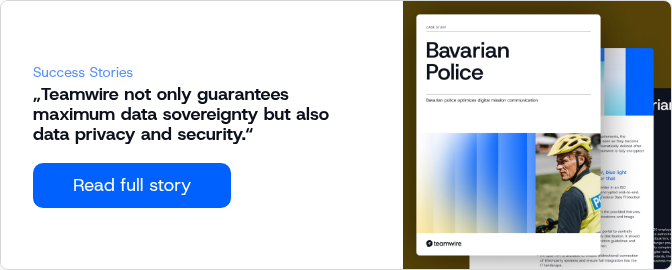
The service is operated in Germany, with the option of a private cloud or a fully on-premises solution. Teamwire is ISO 27001-certified; the data centre used holds a BSI C5 certificate. Development takes place in Germany and Spain. Nationwide, over half of Germany’s police forces rely on Teamwire.
Conclusion
Signal is not a security issue. Signal is a matter of remit: it protects the privacy of individuals, whilst organisations need to safeguard processes, responsibilities and their ability to act.
Anyone who needs to manage, document and, in an emergency, reliably maintain business communications requires a platform that has been built specifically for this task.
The Signal alternative in detail
On our page about Signal alternatives, you’ll find a direct comparison of features, specific use cases by sector, and answers to the most frequently asked questions from tenders and IT audits.

Frequently asked questions (FAQs)
Is Signal GDPR-compliant?
Signal implements key data protection principles in an exemplary manner from a technical perspective: end-to-end encryption, data minimisation, and transparency through open source code. However, the question of GDPR compliance cannot be answered for an app in isolation, but only in relation to a specific processing operation. And the organisation is responsible for this. Without a data processing agreement, without centralised control and without the means to provide evidence, essential building blocks are missing. Furthermore, as a US foundation, Signal is subject to the US CLOUD Act.
Am I allowed to use Signal for work purposes?
Technically, yes; but from an organisational perspective, it rarely makes sense. As soon as work-related data is routed through private accounts, the organisation loses control over access, retention and deletion – and can only fulfil its own audit requirements to a limited extent. In regulated sectors such as law enforcement, critical infrastructure, healthcare, public authorities or financial services, this is hardly justifiable.
Is it enough to roll out Signal via MDM?
No. MDM manages devices, not communications. You can use it to install and update Signal, but you cannot centrally manage groups, roles or communication policies, archive anything in an audit-proof manner, or provide deployment functions. A business messenger combines both: device management via MDM/UEM and centralised communication management in a single platform.
What sets a specialist business messaging app apart from Signal?
It’s not about encryption, but about governance. A business messenger complements secure transmission with centralised administration, role-based access, audit-proof archiving, audit logs, a choice of hosting models, system integrations via APIs, and features for emergency and crisis communication.